
FormBeacon Template Variables for Google Forms
Use FormBeacon's stable Google Forms field variables, Insert all fields action, Basic and Rich modes, safe previews, and missing or multi-value answer handling.
Published · Updated · 13 min read
Preview one stable Basic hiring template
New hiring application
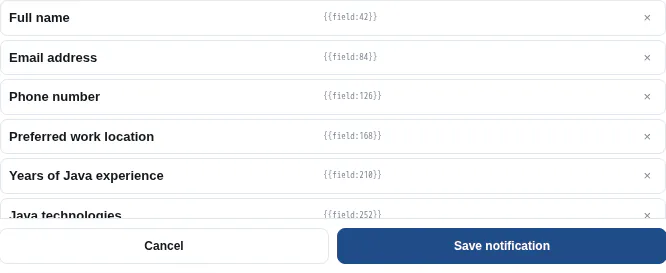
Role: {{field:168}}
Candidate: {{field:42}}
Reference: {{response.id}}

Synthetic preview
Role: Platform Engineer
Candidate: Avery Example
Reference: SYN-1042
The picker stores stable Google item IDs even though the editor shows readable labels. The preview is fictional and does not load, persist, or prove delivery of a real response.
Bind every variable to the intended form item
Start with the action the recipient should take, then choose the shortest message that supports it. Build messages that remain mapped to the intended Google Form items when labels are renamed or duplicated, while keeping respondent values inside safe text positions.
Google exposes a stable item identifier through Google Apps Script Form item reference; FormBeacon uses that identifier instead of a question title as the binding key.
The picker includes form and response metadata, every current field, and Insert all fields. Missing and multi-select answers have predictable provider-neutral text behavior.
Pick a template pattern before editing the words
| Question | Recommended starting point | Trade-off |
|---|---|---|
| One field or all? | Insert only what the reader needs | Every copied value expands the provider's data footprint |
| Basic or Rich? | Basic first | Rich availability and serialization differ by provider |
| Question title as key? | No, use the picker | Titles can be renamed or duplicated |
| Empty optional field? | Render an empty value or omit only where the mode specifies | Never shift another answer into its slot |
Open the variable picker
Place the cursor in a supported text position and open Variables. Metadata appears first, followed by the current form items with their visible labels.

Insert a specific field
Choose a field by its visible label. FormBeacon stores the stable item ID in the variable, so a later label edit does not retarget the message.
Insert all current fields
Use Insert all fields to create provider-neutral field rows in form order. Basic renders Question: value; Rich emphasizes labels only where the selected provider safely supports it.
Choose Basic or Rich
Use Basic on Free or whenever arbitrary text is the priority. Standard and Business can use Rich controls supported by the selected provider.
Preview with synthetic values
The preview uses synthetic values and provider-specific presentation. It does not read or persist a real response and does not prove provider delivery.
Test missing and duplicate labels
Leave an optional item blank, rename one label, and create a duplicate label in a copied test form. Confirm each stable field variable remains attached to its original item ID.
Test multi-select values
Choose several checkbox values and confirm they render as readable text rather than controlling JSON arrays, template slots, or message structure.
Submit one synthetic response
After the saved test succeeds, submit fictional data through the responder view and verify exactly one message at the intended destination.
Adapt the pattern without over-formatting it
For stable Google Forms template variables, start with Basic mode. The variable picker includes form and response metadata plus every current form field keyed by stable Google item ID. Insert all fields creates provider-neutral rows; answer-based conditions and respondent-controlled routing remain unsupported.
The first message for stable Google Forms template variables should identify the form, state when the response was submitted, include only the information the first reader needs, and supply a stable response reference when useful. Put the action before decorative context. On a phone, the first few lines should explain why the alert matters without requiring the reader to expand a card or decode internal abbreviations.
| Format | Best use | Main risk |
|---|---|---|
| Basic | First setup, arbitrary respondent answers, incident fallback | Long forms can still create noisy messages |
| Rich | Supported emphasis, lists, quotes, code, and links on Standard or Business | Each provider supports a different safe subset |
| Advanced | Schema-validated Slack Block Kit, Discord embeds, or Telegram options | Only supported fields and variable positions are accepted |
Advanced mode in stable Google Forms template variables is provider-specific and schema validated. Variable substitution is context-aware and JSON safe, and respondent values remain text: they cannot become keys, object structure, credentials, destinations, template identity, or routing. Basic mode remains the most resilient choice when a workflow does not need provider-specific structure.
Test the template against realistic answer shapes
To accept stable Google Forms template variables, run both a saved configuration test and a real form submission because they answer different questions. The saved test checks whether the current credential, destination, and message can reach the provider. A real submission additionally checks the Google trigger, form binding, response rendering, and delivery path. Both results must succeed.
- 1Create a private test destination or tell the intended channel that a harmless test is coming.
- 2Use a copied form with short fictional values, including one blank optional answer and one value containing punctuation.
- 3Save the simplest supported mode first. Do not begin with a complex provider-specific Advanced structure.
- 4Run the destination test and confirm a harmless notification at the intended destination.
- 5Open the public responder view of the copied Google Form and submit it like a respondent would.
- 6Confirm that exactly one new message appears, that the form title and submission time are plausible, and that the message is visible only to the intended audience.
- 7Repeat once with a multiline answer and non-ASCII text. This catches formatting assumptions that a one-word test will miss.
- 8Return to the add-on and review the visible delivery status without pasting credentials into a support conversation.
When checking stable Google Forms template variables, a working saved test and a failed real submission point to trigger ownership, Google authorization, the selected form, or event eligibility. If neither works, inspect the destination credential and provider permissions first. If delivery succeeds but the content is hard to read, keep the credential unchanged and simplify the template. Changing one layer at a time preserves evidence.
| Observation | Most useful interpretation | Next check |
|---|---|---|
| Saved test fails | Provider credential, destination, configuration, or entitlement problem | Re-enter the credential privately and verify provider-side access |
| Saved test succeeds; form submission does not | Google trigger, authorization, form binding, or event problem | Reopen the add-on as the trigger owner and inspect status |
| One submission creates two messages | More than one active trigger or destination may exist | Inspect active destinations and remove duplicate trigger ownership intentionally |
| Message arrives in the wrong room | The credential points to a different destination | Create or select the credential from the exact target destination |
| Basic works; Advanced fails | The provider-specific Advanced structure is invalid | Use the provider validator and reintroduce fields one at a time |
If stable Google Forms template variables still fails, use the provider-by-provider Google Forms notifications diagnostic guide. Record the test time, form name, destination name, and redacted error code. Never record submitted answers or the secret itself in a shared incident note.
Remove fields the destination does not need
For stable Google Forms template variables, treat every webhook, bot token, and access token as a password. Restrict destination membership and rotate a credential after suspected disclosure.
Every delivery created by stable Google Forms template variables is a new copy of the notification. Google Form sharing does not automatically restrict a Slack channel, Discord channel, Telegram group, WhatsApp recipient, or webhook receiver. Before choosing Insert all fields, review every form question and assume every destination member can read the rendered values. For sensitive workflows, send a minimal reference and instruct authorized staff to open Google Forms rather than copying all answers into a notification.
- Use the narrowest private destination that still supports the workflow.
- Remove webhook URLs, bot tokens, access tokens, and real phone numbers from screenshots and screen recordings.
- Do not submit real customer or employee data while testing.
- Review provider retention, export, moderation, and member-access settings separately from FormBeacon.
- Rotate an exposed credential at the provider, update FormBeacon, and run both tests again.
- Delete test messages that contain even fictional data if they could confuse the operational channel later.
The privacy boundary for stable Google Forms template variables is specific: FormBeacon encrypts channel credentials and templates with versioned AES-256-GCM keys. It does not persist form answers, rendered notification bodies, raw provider payloads, OAuth or identity tokens, or complete billing webhook payloads. Retry storage in Google document properties is limited to form ID, response ID, idempotency key, and attempt count; the response is re-read from Google for a retry.
Those controls do not automatically make every form suitable for stable Google Forms template variables. You remain responsible for lawful collection, notices, consent where required, access control, retention at Google and the provider, and any industry-specific rules. This article explains product behavior and operational precautions; it is not legal advice.
Template variables and routing boundaries
- Variables cannot control a credential, endpoint, channel, chat, phone number, template identity, language, object key, or routing decision.
- Renaming a label changes displayed copy but not the stable item binding.
- A deleted field cannot supply a value; reopen the editor and intentionally revise the template.
- The preview is synthetic and is not proof of Google trigger or provider delivery.
If stable Google Forms template variables requires a behavior listed here as a limit, do not hide the gap with copy or assume a future feature exists. Change the workflow, separate the forms, or choose a system that owns the missing behavior. Clear boundaries make setup and incident response easier.
Fix unreadable messages without changing the credential
| Symptom | Likely cause | What to do next |
|---|---|---|
| Two fields have the same label | Labels are not binding keys | Inspect the picker entry and stable field token |
| A renamed field shows the old label | The template label text is static | Edit the visible label while retaining the variable |
| Optional answer is empty | The respondent skipped that item | Add fallback wording or intentionally omit it |
| Multi-select looks crowded | Several values were flattened into text | Use a list in Rich mode or shorten the choices |
Understand how variables become notification text
In stable Google Forms template variables, Google invokes a user-owned installable form-submit trigger after configuration. The add-on reads the submitted response, renders the selected message, and sends it to FormBeacon's delivery API. The service applies plan limits and idempotency, uses the encrypted destination configuration to call the selected provider, and stores redacted delivery metadata rather than submitted answer content or rendered notification bodies.
That architecture is the diagnostic map for stable Google Forms template variables. FormBeacon is not a direct browser-to-webhook shortcut, and it does operate a delivery service. At the same time, response answers do not become a searchable FormBeacon database. Google Forms remains the record you inspect or correct; the provider receives the message you explicitly send; FormBeacon retains only the bounded configuration and redacted operational data required to deliver and diagnose it.
- 1A respondent submits the Google Form and Google records the response.
- 2The verified form owner’s installable trigger runs for that submission.
- 3The add-on prepares a request containing the form and response references needed for delivery.
- 4FormBeacon validates identity, form entitlement, quota, destination configuration, and idempotency.
- 5The service calls the provider using the credential and destination required by the selected provider.
- 6On success, the service records redacted success metadata and counts one successful outbound destination delivery as one notification.
- 7On failure, the failed attempt does not consume the Free successful-delivery quota; an idempotent retry must not count the same delivery twice.
Before publishing stable Google Forms template variables, check provider behavior against the provider's current official documentation, because provider interfaces, permissions, limits, and policy wording can change. Check FormBeacon's product behavior and prices on the pricing page and in the current add-on rather than inferring them from an old screenshot.
Choose the message by the action it should trigger
The practical goal is Build messages that remain mapped to the intended Google Form items when labels are renamed or duplicated, while keeping respondent values inside safe text positions. A notification becomes useful only when a named person knows what to do after it arrives. Before changing the form, record the form owner, the destination owner, who may see the submitted information, and the action expected from the first reader.
For stable Google Forms template variables, keep Google Forms as the response system of record. FormBeacon delivers a notification; it is not a CRM, ticket database, applicant-tracking system, booking engine, or conditional workflow builder. If the process needs assignment state, approvals, capacity enforcement, scheduled reminders, or answer-based branching, keep those controls in a suitable system and use the message as the prompt to act.
| Decision | Record before setup | Why it matters |
|---|---|---|
| Form ownership | One durable Google account that can edit the form | The installable submit trigger belongs to the account that creates it |
| Destination | the private team destination chosen for the workflow | A technically successful delivery to the wrong room is still a privacy and operations failure |
| Audience | Only people who need the submitted data | The provider retains and displays the delivered message under its own controls |
| First action | A concrete acknowledgement, reply, review, or follow-up | Alerts without an owner quickly become background noise |
| Fallback | How the team checks Google Forms when delivery is unavailable | The notification should not become the only way to find a response |
When rehearsing stable Google Forms template variables, use a copied form and a private test destination. Enter obviously fictional answers. That keeps setup separate from real personal, customer, health, hiring, or payment-related information and makes it safe to repeat tests while permissions are being corrected.
Match the template format to the plan
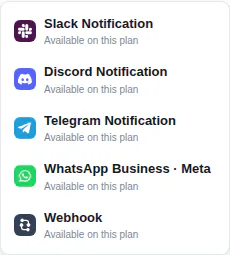
Before launching stable Google Forms template variables, match it to the pricing contract. Free supports one form, one active Basic destination on Slack, Discord, or Telegram, and 100 successful outbound destination deliveries per UTC calendar month. Standard supports up to 10 forms and Basic, Rich, and supported Advanced modes on Slack, Discord, and Telegram. Business adds WhatsApp approved templates, Webhook JSON, a shared 100-form workspace capacity, shared connectors, and unlimited explicitly invited workspace members.
For quota accounting in stable Google Forms template variables, one notification is one successful delivery to one outbound destination. If one response is sent to three active destinations and all three succeed, that is three successful deliveries. A failed delivery does not consume the Free quota, and an idempotent retry of the same delivery must not count twice. The Free counter resets lazily when the UTC month key changes; there is no reset cron to wait for.
Multiple destinations attached to stable Google Forms template variables use fan-out, not conditional routing. Every active destination on the form receives every eligible response. FormBeacon does not inspect an answer and select a destination, severity color, owner, or template branch. To keep different audiences separate, use separate forms or a workflow system that explicitly implements rules, and test that system with representative data.
Verify current FormBeacon amounts and included features for stable Google Forms template variables on the pricing page. Product prices and provider charges are different: Meta or another provider may apply its own usage charges, taxes, or policies, and those charges are not replaced by a FormBeacon subscription.
Keep templates aligned with form questions
Treat stable Google Forms template variables like a small operational system. Name a form owner and a destination owner, document the purpose without recording secrets, and schedule a periodic harmless submission. Retest after changing form ownership, Google authorization, questions, destination membership, channel structure, webhook or bot settings, Meta templates, or the FormBeacon plan.
- Keep a copy of the intended message structure without any credential or real response data.
- Review whether every destination member still needs access to the notification content.
- Remove unused destinations before creating new ones so fan-out remains understandable.
- Use provider audit or administration features to investigate credential changes where available.
- When an owner leaves, deliberately transfer the Google Form and recreate or verify the user-owned trigger under the intended owner.
- During an incident, preserve timestamps and stable error codes, but redact identities, credentials, answers, and complete payloads.
The fallback for stable Google Forms template variables should remain visible: authorized staff can open Google Forms and inspect responses when chat delivery is delayed. Do not delete or mutate a form response simply because a notification failed. Repair the delivery path, make a harmless test, and use the response reference to reconcile operational action without copying the original answers into troubleshooting logs.
Frequently asked questions
- Does FormBeacon still support an all-answers token?
- No. Use Insert all fields, which creates stable provider-neutral rows for the current form items.
- What happens when I rename a question?
- The saved variable remains bound to the same Google item ID. Update any static label text if you want the notification to show the new wording.
- Can a response choose the destination?
- No. Values are text and cannot change credentials, endpoints, recipients, routing, or template identity.
- Does preview use my latest answer?
- No. Preview uses synthetic values so real form answers are not persisted or exposed during authoring.
Set this up on your own form
Follow the installation guide to install the add-on, connect a destination and send a test alert. FormBeacon does not persist form answers or rendered notification bodies.